14 Nights / 15 Days Arusha, Mt. Meru, Tarangire National Park, Lake Manyara National Park, Ngorongoro Conservation Area & Serengeti National Park
From
Duration
Tour Type
Explore Tours
Day 1
Arusha
Arrive Kilimanjaro International Airport ex – TBA
Meet, greet, and transfer to Arusha Planet Lodge. It is a stunning lodge at the base of Mount Meru that offers a great view of both Mount Meru and Kilimanjaro. After a while, our safari manager will come for a safari briefing and leave you to enjoy the rest of the day at the lodge.
You will be relaxing while looking forward to your great Tanzania safari.
Removed from the noise of downtown Arusha and set in leafy grounds, Arusha Planet Lodge is a good base as you pass through northern Tanzania. The rooms have balconies that look out on the trees, and the interiors have splashes of colour. The restaurant is a good place to enjoy local cooking, and you can relax in the bar.
Day 2
Momella Gate (1500 M) –Miriakamba Hut (2541 M)
Walking Time: 4-6 Hours
After breakfast drive to Momella gate in Arusha National Park. Driving takes about 1 hour. At the gate you will clear your trekking permits, meet up with your porters, guide, cook and game ranger, and start climbing. You will pass open grassland which will give you a good opportunity to see buffaloes, warthogs and other grazers.
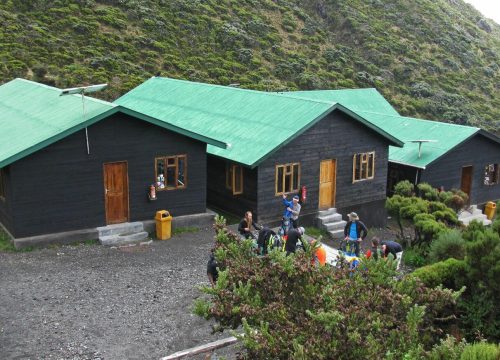
You will cross the Ngare Nanyuki River and continue climbing through mountain forest. There you will have chance to see different kinds of birds and black and white colobus monkeys. Finally, you will reach Miriakamba Hut where you will have dinner and an overnight stay.
Day 3
Miriakamba Hut (2541 M) – Saddle Hut (3570 M)
Walking Time: 3-5 Hours
Second day climbing is quite short but demanding. You will start early in the morning and ascent steeply through lush mountain forest full of birds to reach the halfway point of Elephant Ridge. There you can see the crater. After 3 to 5 hours climbing, you will reach Saddle Hut where you will have lunch.
In the afternoon you will have another hiking to Little Meru (3794 m) for superb views before sunset. Then you will return to Saddle Hut for dinner and overnight. It is good to go to sleep early so that you get enough rest for the next day’s hiking.
Day 4
Saddle Hut (3570 M) – Rhino Point (3850 M) – Peak (4566 M) – Rhino Point (3850 M) – Saddle Hut (3570 M) – Miriakamba Hut (2541 M)
Walking Time: 10-12 Hours
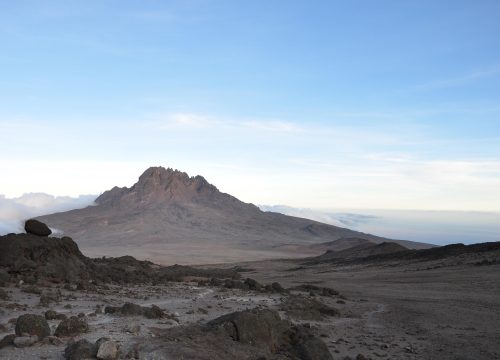
You will start climbing between 1 to 2 at night. The route is very steep towards Rhino Point (3850 m) and from there towards the summit along very narrow ridge. You will reach the Mount Meru Summit, Socialist Peak, (4566 m) right at the sunrise.
The sceneries there are stunning; you will see Mount Kilimanjaro in close distance. After taking photos on the summit you will descent back to Saddle hut.
Note: On icy conditions or strong wind it is not necessarily possible to pass the ridge between Rhino Point and summit. Your guide will decide if the conditions are not good enough to continue.
Day 5
Miriakamba Hut (2541 M) – Momella Gate (1500 M)
Walking Time: 2-5 Hours
You will leave about at 8.00 in the morning and descent to Momella gate. You can choose longer or shorter route down. On the longer way down you have very good changes to see wildlife and the ash cone. Once at the gate, it is time to tip your porters, guide, cook and game ranger. After that you will be picked up and transferred back to Arusha Planet Lodge for lunch, leisure, dinner and overnight stay.
Day 6
Arusha – Tarangire National Park
Morning departure from Arusha to Tarangire National Park
Game drive in the pack
Tarangire National Park (2,600km2) has unrivalled landscape of open plains, dotted with thousands of baobabs. It is located about 120kms south of Arusha. Tarangire is known for its lions and very big herds of buffalo. This is one of Africa’s little-known gems and should be on the itinerary of all lovers of wilderness and solitude. The animals include zebra, wildebeest, buffalo, elephant, Maasai giraffe and fringe-eared oryx (gemsbok). Predators include lion, cheetah and leopard. Birders will want to look out for the endemic ashy starling, rufous-tailed weaver and black-collared lovebird.
Hot lunch at Tarangire Safari Lodge
Lunch, dinner and overnight Tarangire Safari Lodge
Day 7
Tarangire – Lake Natron
After breakfast drive to Lake Natron
Lunch at Lake Natron Halisi Camp
Afternoon you walk to Lake Natron
Dinner and overnight at Lake Natron Halisi Camp
Day 8
Lake Natron – Serengeti National Park
After breakfast collect picnic lunch and drive to Serengeti National Park
Afternoon en-route game drive in Serengeti National Park
This park is renowned for being the location of the Great Wildlife Migration, which involves over two million wildebeests, zebras and antelopes. It is also an extremely large and wild game park, and home to the Big Five of Africa.
Dinner and overnight at Lobo Wildlife Lodge
Day 9
Serengeti National Park
After breakfast collect picnic lunch and embark on a full day game drive to Central Serengeti
Dinner and overnight at Tanzania Bush Camp Central Serengeti
Day 10
Serengeti National Park
After breakfast embark on another morning and afternoon game drive in Serengeti National Park (or full day game drive with picnic lunch)
Dinner and overnight at Tanzania Bush Camp Central Serengeti
Day 11
Game Drive in Search of the Great Migration
After breakfast embark on a full day game drive in Serengeti National Park with picnic lunch for a chance to see the great herds of wildebeest, zebras and gazelles or a pride of lions lounging in the shade. The Serengeti, one of the largest parks in Africa at 15,000 sq km, is home to some three million large mammals and is made up of a diversity of landscapes with the southern region being dominated by the lush grassy plains that draw about two million wildebeest, half a million zebra and some quarter million antelope to make the hazardous journey in search of pasture when the autumn rains come.
Dinner and overnight at Tanzania Bush Camp Ndutu
Day 12
Game Drive in Search of the Great Migration
The Great Migration (also referred to as “Serengeti Migration”) is arguably the greatest wildlife show on earth. It is the largest single movement of wildlife on earth in search of water, pasture, and breeding grounds. Other than the great migrating herds we seek, we may also see cheetah, lion, leopard, buffalo, elephant, wildebeest, hartebeest, topi, eland, crocs, Thomson’s and Grant’s Gazelle, amongst many more. With over five hundred bird species identified, the park is a veritable ornithological paradise, ostrich abound, secretary bird, marabou stork, and the largest flighted bird on Earth, the kori bustard. We will seek out these creatures with the keen intuition and experience of our “Wild guide” and, with day drawing to a close, we will wend our way to our camp to unwind, dine and take our ease by the fire under the endless East African sky.
Dinner and overnight at Tanzania Bush Camp Ndutu
Day 13
Serengeti – Ngorongoro Conservation Area
After breakfast collect packed lunch and drive to Ngorongoro Conservation Area
Descend 2000 feet (over 600 meters) to the floor of the crater (more precisely a caldera). This 304 square kilometre enclosed ecosphere was formed some two or three million years ago in the massive explosion of a volcano once higher than Kilimanjaro, and offers the best game viewing opportunities in all of Tanzania.
Explore the forest areas inhabited by monkeys and elephant, the lake area, where you may see the flamingos and the open savannah where the lions hunt for food. With some 25,000 large mammals within the caldera, you will have the opportunity to see, in addition to ‘the big five’ (elephant, lion, rhino, buffalo, and leopard), animals such as wildebeest, gazelle, reedbuck, bushbuck, hartebeest, hippo, antelope, both Grant’s and Thompson’s gazelle, impala, to name a few, as well as over 500 bird species.
Dinner and overnight at Rhino Lodge
Day 14
Lake Manyara National Park
After breakfast drive to Lake Manyara National Park
Game drive in the park with picnic lunch
This is one of the most diverse of Tanzania’s national parks, a tiny (325km2) combination of Rift valley lake, dense woodlands and steep mountainside. Manyara is a birding paradise (more than 380 species), especially for waterfowl and migrants and the forests are one of the best places around to see leopards. Lions hunt on the grassy shores of the
lake. Most visitors tailor a visit to Manyara to fit in with a trip to one of the Big Three parks (Serengeti, Tarangire and Ngorongoro).
Dinner and overnight Kirurumu Tented Lodge
Day 15
Arusha
After breakfast drive back to Arusha and drop-off at the airport for your onward flight.
End of our services